fatal error drawing on profiles civil 3d
Yes, I know Ceremonious 3D 2012 is coming out presently and aye, I'll probably mail service about the tools that I recollect will be the most beneficial (I'll let everyone else mail the "Hey! Civil 3D 2012 is coming out!" posts) but sometimes things slip through the cracks and yous notice out there are cool new things bachelor for what you lot already have.
Now, my question is; How did I miss this? Did this just come out? I did a search online and I tin only find one reference to this outside of the Autodesk website so I'thousand assuming this is something actually new (please correct me if I'm wrong). I probably missed it considering of all of the focus on the announcements of the new AutoCAD Civil 3D 2012 that will be coming out presently.
I of the fine folks I follow on Twitter just posted a link to the Transportation Extension for AutoCAD Civil 3D 2011. I had never heard of such a thing then I went investigating and I found some really cool tools are available to everyone that has Civil 3D 2011. It'south not on the subscription site then I'k pretty sure it's for everyone. Go to the home folio for Civil 3D (http://www.autodesk.com/civil3d) and click on the Back up link, then the Utilities and Drivers link (a direct link to the page can be found HERE). Nether AutoCAD Civil 3D 2011, you lot'll come across something called, "AutoCAD Civil 3D Transportation Extension".
"What is this?" you may enquire yourself, well, let me tell you what I've found out so far. It seems to be a bunch of additional tools that volition run on tiptop of Civil 3D 2011, and at that place looks to be some great tools in here. Allow me to list them for you and then later on I will become into greater detail nigh them (at least the ones I've figured out so far):
i) Cheque Alignment Geometry
two) Quick Cantankerous Department
three) Surface Loftier/Low Points
four) Import Raw Information
five) Create Surface from Photogrammetric Data
6) Export Civil Information
7) Show/Hibernate Labels
8) Consign Layout to DGN
9) Eleven New Reports (according to the readme)
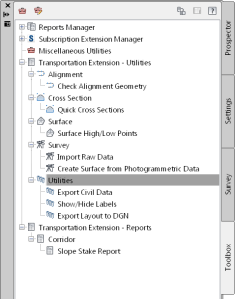
Transportation Extension Tools
That's a lot of cool stuff they've given away for free (call up, this isn't on the subscription website). Then, let'due south accept a peek at what these tools will exercise.
1) Check Alignment Geometry
Have you lot e'er created an alignment from existing entities and later institute that those lines and curves that you received from the planner or surveyor or whoever weren't tangent? Well, worry no more than. This is a great little tool. In testing it, I created a polyline with a line segment, a tangent curve off the terminate of it, and then a line from the cease of the curve that I drew and so information technology looked tangent to the curve, simply wasn't really tangent. I created an alignment from this polyline and so ran this tool on the newly created alignment. After running the command, information technology prompts you to select the alignment and and so asks you lot to "Enter gap tolerance". I'one thousand non exactly sure what the gap tolerance is just probably has something to do with gaps in the alignment. There is no assist so I tin can't do any research on information technology and the footling chip of testing I've done has helped me figure it out either. Next, it's going to enquire you to "Enter angle tolerance". Over again, I'k not exactly sure what the angle tolerance means simply every time I've run information technology, I've used the default setting and it does something. So, what does it do to our instance of a not-tangent line connected to an arc? Well, it makes them tangent. In addition to that, it place a PI at the point of intersection of the two lines (very convenient).
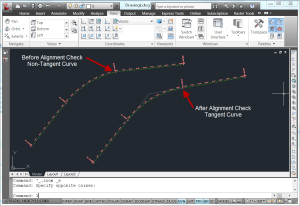
Alignment Check
2) Quick Cross Department
This is an interesting ane and I'm not sure how useful it will be but, I'll explain what I know about it. The Quick Cross Department command works very similarly to the Quick Profile control. I desire to come across what my cross sections will expect like (real apace) created from a line between here and at that place. Well, run the command and information technology will create them for y'all, all you need is a drawing with a surface in information technology. Once the command is run, it will prompt you for the surfaces you want to display in the sections and then it volition prompt y'all for "Enter an pick [3p/Multi]". I oasis't tested the 3p choice yet merely Multi volition let you to pick points on the screen that will basically define the alignment you want to create the sections for. It will then prompt you lot for the sampling interval, the left and and then the correct swath width and where yous desire the sections to be displayed in the drawing. After you accept entered that, a dialog box volition exist displayed that will ask you for the appropriate styles, Section Way, Section View Style, and Band Style Set (apparently there is no selection for labels). Once you hit OK, the sections will be displayed in your drawing. Similar a Quick Profile, the Quick Cantankerous Sections are temporary. Unlike the Quick Profile, the Quick Cantankerous Sections will immediately disappear when y'all terminate the control, rendering it (in my opinion) fairly useless.
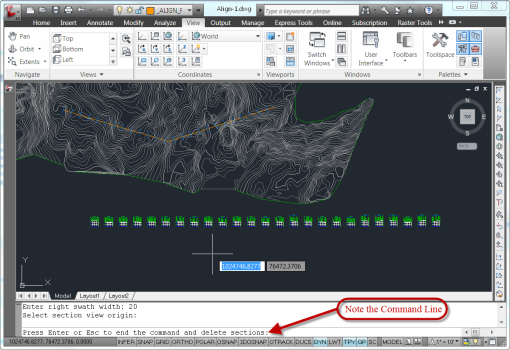
Quick Cross Sections
iii) Surface Loftier/Low Points
This command looks pretty cool. It will analyze a surface and place points at the high points and at the low points. You can so use the Low Point points as the starting bespeak for the Catchment Area command. Basically, just run the command, and then select the area of the surface y'all desire to be analyzed (if yous want it to analyze the unabridged surface, just hit enter). Information technology will as well create 2 signal groups, 1 for the high point points and one for the depression point points (pretty convenient, huh?). You can then use these indicate groups to control the display (too as the clarification) of the points.
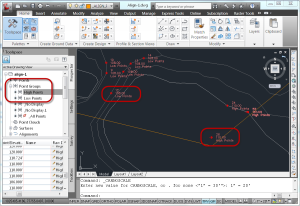
High/Low Points
4) Import Raw Data
I wasn't able to test this one out as I didn't have any file types that would be needed for this command to work merely, here is what I Retrieve information technology will do. It will have a Star*Net .dat file and convert it into a fieldbook file (for more data on Star*Net click HERE). From the import dialog box, there seem to be quite a few options.
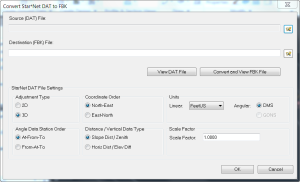
Import Raw Data
5) Create Surface from Photogrammetric Data
This one looks cool. I haven't tested it out completely yet simply, basically run the command and it will inquire you what layer your data is on. Select the layers for both the linework and the signal data (you lot have to give them names), select the surface you want to add them to (or have it create a new surface for you) and you're done. I tested information technology with a bunch of contours and it didn't give me the option to minimize flat faces (apparently they didn't remember that yous could use this for contour data).
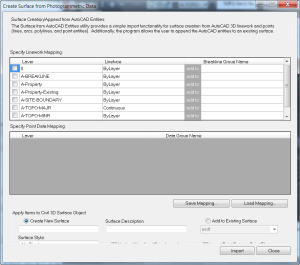
Create Surface from Photogrammetric Data
It appears in that location seems to be a slight event with the dialog box. The bottom of it is cut off and no matter how you re-size the dialog, it doesn't seem to fix it. If you are familiar with creating surfaces in Civil 3D, yous shouldn't have whatsoever trouble figuring out what is being cut off.
half-dozen) Export Civil Data
This is another 1 that I haven't been able to exam out as I don't have any survey equipment. According to the readme file that comes with the extension, "Consign Civil Data (to survey formats – RD5 and TP5) – enables users to export Ceremonious 3D alignments, profiles, and corridors to a TDS .rd5 roadway file and/or .tp5 template file." The dialog box asks you to select the Alignment, Profile, and (or?) the Corridor and it will create the .rd5 and the .tp5 files for you.
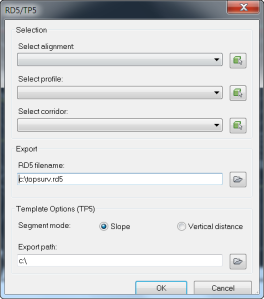
Export Civil Data
Export Civil Data
7) Show Hide Labels
This is another one of those tools that looks pretty absurd. Have you ever been looking at a drawing and though to yourself, "Man, I wish I could just get rid of those labels temporarily. It sure would make it easier to run across what was going on!" Well, now you can. But run this command and the select the label types you lot desire to hide and the ones you want to no longer be subconscious. There's fifty-fifty an option at the top to hide all labels or evidence all labels. Pretty slick in my stance.
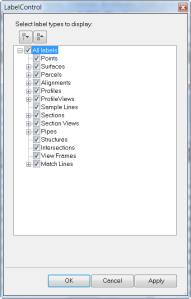
Prove/Hibernate Labels
Prove/Hibernate Labels
8) Consign Layout to DGN
Pretty self explanatory here I would assume. It allows yous to export a layout tab to a .dgn file. Again, I can't truly test this one as I don't have Microstation installed and I don't have a "seed file". It seems straight frontward though. Information technology will export each sheet (or only the ones you select) from a Sheet Gear up Managing director file (.dst) to a .dgn file
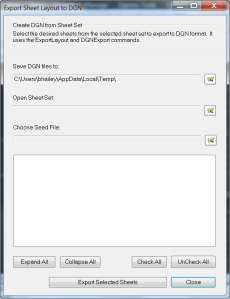
Export Layout to DGN
9) New Reports
According to the read-me, there are 11 new reports. Well, I have no reason to uncertainty that but, when you install it, there is a new report category and it only shows i new written report so the other new reports must be included in the other report categories somewhere (I don't have a listing of them or of the originals that come with C3D to compare my current listing to). The ane that does show up (Corridor->Slope Stake Report) is pretty slick equally it will actually display the cross sections in the written report for a visual confirmation of the information.
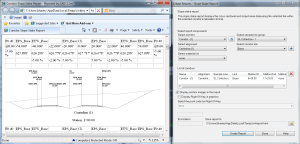
Slope Stake Study
Wrap Up
As I said, there are some pretty cool new tools here so exit and try information technology for yourself. Let me know what yous think, what reports y'all similar that are new with this, etc. Likewise note that when you download it, you lot can also download the CalTrans Content Kit subsequently y'all install these tools. Looks similar I may have another post to write up about that.
Source: https://civil3dplus.wordpress.com/tag/profile/
0 Response to "fatal error drawing on profiles civil 3d"
Post a Comment