civil 3d drawing site plan
Create a 3D Site Programme Using CADMapper and AutoCAD
Need to apace create a 3D site program in AutoCAD?
Hither'due south how to practice it.
This tutorial covers the following information:
-
Setting up a 3D site in CADMapper
-
Converting Units: Metric to Imperial
-
External References: Separating Layers into Drawings
Disclosure:
CADMapper is a website that can salve architects, designers, and planners tons of time by automatically generating 3-Dimensional information for over 200 cities around the globe. CADMapper generates 3D models that can be used with AutoCAD, Sketchup, Rhino, and Illustrator. To generate information for topography, buildings, and streets, CADMapper pulls data from OpenStreetMap.
I should kickoff by saying that my pattern work primarily involves the schematic design phase of architectural design. I understand that site information should be field-verified past professionals in surveying, civil engineering, etc. to ensure accuracy. The intention of this tutorial is to employ CADMapper to create a basis for architectural schematic designs.
Setting up a 3D site in CADMapper
Stride 1: Detect your site - Start with Google Maps.

I like to start by finding my site in Google Maps. Oftentimes, there is little information given that specifies coordinates or a concrete address of a site. Searching for the site in Google Maps gives me a meliorate understanding of what my site looks similar from an aerial perspective.
Once you find your site in Google Maps, head over to CADMapper.com and type in the approximate address - or ii intersecting streets.
CADMapper just provides vector line information, and then it might be cumbersome to try to search for your site starting in CADMapper. Look between Google Maps and CADMapper to strop in on your site, and create a box in CADMapper that captures the information y'all need from your site. CADMapper is free, but up to 1km of information.
Always endeavor to capture more information than you remember you demand. You never know when you might demand the data in the time to come. It'southward better to accept it and non need it, than to need it and not take it - I've had to sew together multiple CADMapper files together before because I left out some of import information when I created my initial file, and information technology's a real pain to go through that process.
Footstep ii: Turn on 3D Buildings

If you lot desire building pinnacle information, check the box for 3D Buildings. If building information is available (which information technology oft is in large cities), CADMapper volition create mesh geometry of buildings in the CAD file. Yous can specify "Simulated Height Data", in which CADMapper will generate buildings without height information to a value that you specify. Not a necessary footstep, but it can you relieve drawing time.
Pace three: Select 3D Topography, topography contours spaced at 4 meters.

Information technology's good do to just collect as much information as nosotros can go, early in a project. The lowest spacing that CADMapper volition generate for contour lines is 4 meters, which should be plenty of data to go you started in your design.
Step 4: Route Geometry, Select "Outlines"

CADMapper provides options for generating road graphics. Roads can be depicted as single center-lines, outlines, or mesh surfaces. If you intend on using this site file for fabrication, such every bit 3D press or laser-cutting, I would advise choosing an option that best suits your needs. For this tutorial, selecting "Outlines" will provide graphic separation betwixt types of roads, and allow piece of cake scaling of the cartoon in AutoCAD. Additionally, "Outlines" is a skilful option to choose for laser-cut site models.
Alter the route dimensions to specific dimensions: I recommend the following:
-
Highways: 10 meters
-
Major Roads: 8 meters
-
Modest Roads: 6 meters
-
Paths: iv meters
Step 5: Generate the CADMapper File

If everything is set to your liking, click on "Create File". It will take a moment to generate the file.
In one case the file is generated, you can examine the map in 3 views:
-
3D Axonometric View
-
2D View
-
Topography
At this point, select download. The file will download as a single .nada, containing one .dxf file that you tin open up with AutoCAD.
Converting Units - Metric to Majestic
By default, CADMapper exports units in meters. For our purposes, nosotros need to convert meters to feet.'

Step one: In the "Units" Menu, Alter 'Decimal' to 'Architectural'
Type in command, "UN" to open up the Units menu. Change 'Decimal' to 'Architectural', and 'Millimeters' to 'Inches', respectively. Note that simply irresolute the units volition not change the scale the cartoon. For example, 2 meters will be converted to 2 anxiety, which is incorrect.
So, we'll need to scale the drawing afterward changing the units from metric to imperial.

Step 2: Verify the Altitude of a Route
Employ the control "DIST" to measure the distance of 1 of the roads generated by the CADMapper file. Information technology should read as ane of the measurements that was specified on the CADMapper website. For this example, the road is 6 meters.
Step 3: Calibration the Drawing
If the road altitude is 6 meters, it will demand to be scaled to 19.685 feet (considering one meter = 3.28084 feet) after changing the Units from metric to imperial.
Draw a polyline (command "PL") off to the side of your drawing in model space somewhere. Below that 6 meter line, draw a line of altitude, 19.685.
Use command "AL" for 'Align', and select EVERYTHING in model space. Deselect the (19.685) line. We want to calibration everything in the drawing except that line.

Select the beginning point of the (half-dozen units) line, and the first point of the (19.685 units) line. Then, select the 2d point of the (6 units) line, and the second point of the (19.685 units) line.
When prompted to 'Scale', select Yes.
If done correctly, all of the elements in the drawing volition take scaled with the (6 units) line, which now matches the distance of 19.685. So now, when the Units are set up to "Architectural" and "Inches", all of the roads should read every bit the equivalent royal measurement.
External References: Separating Layers into Drawings

CADMapper conveniently sorts drawings elements into separate layers. This is useful in terms of organization, yet, nosotros should set up up our drawings in a fashion that allows multiple people to work on them. This may not exist necessary for your detail project, but information technology'south skillful practice to learn the conventions of creating external references to keep file systems organized, and to allow the potential for multiple people to work on a single project.
Streamlined file systems = saved time on drafting piece of work. And saving drafting time volition open up up time for more of import stuff, like designing!
Hither'southward how to quickly create external references from layers:
Step 1: Open the Layer Carte du jour


Type "LA" to open up the Layer Card. Freeze all layers, then unfreeze the first layer that you want to convert into an external reference. In this case, we'll start the the layer chosen "buildings".
Adjacent, type "Select" and "All" to select everything on that layer.
"Copy Base" with, CRTL+SHIFT+C, and so specify the origin point as 0,0,0 (10,y,z, respectively).
This is important, considering copying the information with the origin signal will permit you lot to bring all of the drawings into the new "Main Drawing" at the same point. This will ensure that the drawings are lined up correctly, maintaining accurateness in the information.
Pace 2: Create the "Master Drawing"
Open a new drawing. This will become the "Master Drawing", which will hold all of the xrefs that we volition be creating for each layer. The "Master Drawing" volition look exactly like the original file containing all of the private layer information. The benefit of setting up a master drawing this way, is that multiple people tin can work on individual files within one projection.
For example, ane person tin work on the "Buildings" layer. Another person tin work on the "Roads" layer, and so on.
This is not only convenient for group drafting projects, but it will aid y'all build a consistent file system that can be applied to a number of different programs exterior of AutoCAD. It's but a organisation of file linkage, and these types of systems offer the most flexibility for organization, and drafting workflows.
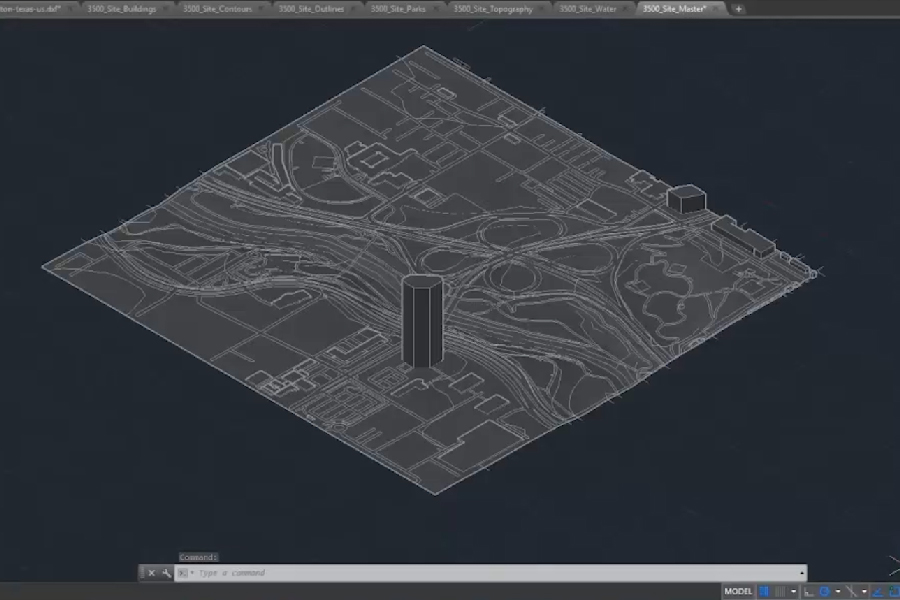
I final notation: the "Master Drawing" should serve equally a file for reference, and should non be drawn on or referenced to other drawings. Changes made on all of the other external references volition reflect on the Master Cartoon, however, changes made on the Principal Drawing will non reflect on the linked external references. It's a one-manner street, and maintaining this system volition ensure that your projection is clean and organized.
Good luck!
Yous might also similar…
Source: https://rascoh.studio/blog/3d-site-plan-cadmapper-autocad-tutorial
0 Response to "civil 3d drawing site plan"
Post a Comment