Where Can I Watch My Fair Lady Online
| My Fair Lady | |
|---|---|
 Theatrical release poster by Nib Gold; | |
| Directed by | George Cukor |
| Screenplay by | Alan Jay Lerner |
| Based on |
|
| Produced by | Jack L. Warner |
| Starring |
|
| Cinematography | Harry Stradling |
| Edited by | William H. Ziegler |
| Music by | Frederick Loewe |
| Production | Warner Bros. |
| Distributed by | Warner Bros.[a] |
| Release appointment |
|
| Running fourth dimension | 170 minutes[iii] |
| Country | Us |
| Language | English |
| Budget | $17 million[2] |
| Box office | $72.vii meg[2] |
My Fair Lady is a 1964 American musical one-act-drama film adjusted from the 1956 Lerner and Loewe stage musical based on George Bernard Shaw's 1913 stage play Pygmalion. With a screenplay past Alan Jay Lerner and directed by George Cukor, the motion-picture show depicts a poor Cockney flower-seller named Eliza Doolittle who overhears an big-headed phonetics professor, Henry Higgins, as he casually wagers that he could teach her to speak "proper" English, thereby making her presentable in the high society of Edwardian London.
The moving-picture show stars Audrey Hepburn as Eliza Doolittle and King Harrison every bit Henry Higgins, with Stanley Holloway, Gladys Cooper and Wilfrid Hyde-White in supporting roles. A disquisitional and commercial success, it became the second highest-grossing film of 1964 and won eight University Awards, including Best Moving-picture show, Best Histrion, and All-time Director.[4] In 1998, the American Movie Plant named information technology the 91st greatest American film of all time. In 2006 it was ranked eighth in the AFI'south Greatest Picture Musicals list.
In 2018, the film was selected for preservation in the U.s. National Film Registry by the Library of Congress as beingness "culturally, historically, or aesthetically pregnant."
Plot [edit]
In London, Professor Henry Higgins, a scholar of phonetics, believes that the accent and tone of ane's voice determines a person's prospects in club ("Why Can't the English?"). At the Covent Garden fruit-and-vegetable market 1 evening, he meets Colonel Hugh Pickering, himself a phonetics practiced who had come from India to come across him. Higgins boasts he could teach even Eliza Doolittle, the young flower seller woman with a strong Cockney emphasis, to speak and then well he could laissez passer her off as a duchess at an embassy ball. Eliza's appetite is to work in a bloom shop, but her accent makes that incommunicable ("Wouldn't It Be Loverly"). The following morning, Eliza shows up at Higgins' domicile, seeking lessons. Pickering is intrigued and offers to cover all the attendant expenses if Higgins succeeds. Higgins agrees and describes how women ruin lives ("I'm an Ordinary Man").
Eliza's father, Alfred P. Doolittle, a dustman, learns of his daughter's new residence ("With a Little Bit of Luck"). He shows up at Higgins' business firm three days later, ostensibly to protect his daughter's virtue, but in reality to extract some money from Higgins, and is bought off with £5. Higgins is impressed by the human's honesty, his natural souvenir for language, and especially his brazen lack of morals. Higgins recommends Alfred to a wealthy American who is interested in morality.
Eliza endures Higgins' demanding instruction methods and handling of her personally ("Just You Wait"), while the servants feel both annoyed with the noise equally well as sorry for Higgins ("Servants' Chorus"). She makes no progress, merely just as she, Higgins, and Pickering are about to give upward, Eliza finally "gets it" ("The Pelting in Spain"); she instantly begins to speak with an impeccable upper-class emphasis, and is charmed at her breakthrough ("I Could Have Danced All Night").
Every bit a trial run, Higgins takes her to Ascot Racecourse ("Ascot Gavotte"), where she makes a good impression initially, only to daze everyone by a sudden lapse into vulgar Cockney while cheering on a horse. Higgins partly conceals a smile behind his mitt. At Ascot, she meets Freddy Eynsford-Hill, a young, upper-form man who becomes infatuated with her ("On the Street Where You Live").
Higgins then takes Eliza to an embassy ball for the concluding examination, where she dances with a strange prince. Likewise present is Zoltan Karpathy, a Hungarian phonetics skilful trained by Higgins, who is an impostor detector. Subsequently he dances with Eliza, he declares that she is a Hungarian princess.
Afterward, Eliza's hard work is barely acknowledged, with all the praise going to Higgins ("You Did It"). This and his callous treatment of her, especially his indifference to her future, causes her to walk out on him, but not before she throws Higgins' slippers at him, leaving him mystified past her ingratitude ("Just You Wait (Reprise)"). Outside, Freddy is still waiting ("On the Street Where You Live (Reprise)") and greets Eliza, who is irritated by him as all he does is talk ("Evidence Me"). Eliza tries to return to her sometime life but finds that she no longer fits in. She meets her father, who has been left a large fortune by the wealthy American to whom Higgins had recommended him, and is resigned to marrying Eliza's stepmother. Alfred feels that Higgins has ruined him, lamenting that he is now leap by "middle-class morality", in which he gets drunkard before his wedding day ("Go Me to the Church building On Time"). Eliza eventually ends upwardly visiting Higgins' mother, who is outraged at her son's draconian behavior.
The side by side solar day, Higgins finds Eliza gone and searches for her ("A Hymn to Him"), somewhen finding her at his mother's business firm. Higgins attempts to talk Eliza into coming back to him. He becomes angered when she announces that she is going to ally Freddy and become Karpathy's banana ("Without You"). He makes his way home, stubbornly predicting that she will come itch back. However, he comes to the unsettling realization that she has become an important part of his life ("I've Grown Accustomed to Her Face"). He enters his house feeling lonely, reflecting on his draconian behaviour and missing Eliza so much that he turns on his gramophone and listens to her phonation. Of a sudden, Eliza reappears at the door and turns it off to catch his attention, with Higgins asking, "Eliza, where the devil are my slippers?".
Bandage [edit]
- Audrey Hepburn as Eliza Doolittle
- King Harrison as Professor Henry Higgins
- Stanley Holloway as Alfred P. Doolittle
- Wilfrid Hyde-White equally Colonel Hugh Pickering
- Gladys Cooper as Mrs. Higgins
- Jeremy Brett equally Freddy Eynsford-Loma
- Theodore Bikel as Zoltan Karpathy
- Mona Washbourne every bit Mrs. Pearce, Higgins' housekeeper
- Isobel Elsom as Mrs. Eynsford-Hill
- John Holland equally the Butler
Uncredited:
- Henry Daniell every bit the British Ambassador (in his last film role)
- Charles Fredericks as the King in Eliza'southward fantasy
- Lillian Kemble-Cooper equally Female Ambassador (in yellow dress) at the brawl
- Queenie Leonard equally Cockney bystander
- Moyna Macgill equally Lady Boxington
- Alan Napier as Gentleman who escorts Eliza to the Queen of Transylvania
- Betty Blythe as Lady at the ball
- Marjorie Bennett as Cockney with pipe
- Philo McCullough equally Brawl Invitee
- Barbara Pepper as Doolittle's dancing partner[5]
- Baroness Rothschild as the Queen of Transylvania
- Walter Burke as Cockney eyewitness telling Eliza about Higgins taking notes well-nigh her
Musical numbers [edit]
- "Overture" – played by orchestra
- "Why Can't the English Learn to Speak?" – performed by Rex Harrison, Wilfrid Hyde-White and Audrey Hepburn
- "Wouldn't It Exist Loverly?" – performed by Audrey Hepburn (dubbed by Marni Nixon) and chorus
- "An Ordinary Homo" – performed by Rex Harrison
- "With a Petty Bit of Luck" – performed by Stanley Holloway, John Alderson, John McLiam, and chorus
- "Simply You lot Wait" – sung by Audrey Hepburn (partially dubbed past Nixon) and Charles Fredericks
- "Servants Chorus" – sung by Mona Washbourne and chorus
- "The Pelting in Spain" – performed by Rex Harrison, Wilfrid Hyde-White, and Audrey Hepburn (partially dubbed by Nixon)
- "I Could Have Danced All Dark" – performed by Audrey Hepburn (dubbed by Nixon), Mona Washbourne and chorus
- "Ascot Gavotte" – sung by chorus
- "Ascot Gavotte (Reprise)" – sung past chorus
- "On the Street Where You Alive" – sung past Jeremy Brett (dubbed past Bill Shirley)
- "Break" – played by orchestra
- "Transylvanian March" – played by orchestra
- "Embassy Waltz" – played by orchestra
- "You Did It" – performed by King Harrison, Wilfrid Hyde-White, and chorus
- "Just You Wait (Reprise)" – sung past Audrey Hepburn
- "On the Street Where You Live" (reprise) – sung by Jeremy Brett (dubbed by Shirley)
- "Show Me" – performed by Audrey Hepburn (dubbed past Marni Nixon) and Jeremy Brett (dubbed by Shirley)
- "Wouldn't It Exist Loverly" (reprise) – performed by Audrey Hepburn (dubbed by Marni Nixon) and chorus
- "Become Me to the Church on Time" – performed by Stanley Holloway, John Alderson, John McLiam, and chorus
- "A Hymn to Him (Why Tin't A Woman Exist More Like a Man?)" – performed by Rex Harrison and Wilfrid Hyde-White
- "Without You" – performed by Audrey Hepburn (dubbed past Nixon) and King Harrison
- "I've Grown Accustomed to Her Confront" – performed by Male monarch Harrison
- "Finale" – played by orchestra
The partly-spoken delivery of the songs given past Harrison is a well-known example of sprechstimme.[six] [7]
Production [edit]
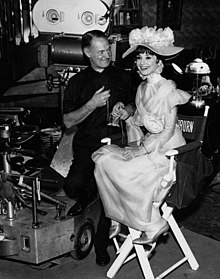
CBS caput William S. Paley financed the original Broadway product in exchange for the rights to the cast album (through Columbia Records). Warner Bros. bought the moving-picture show rights in February 1962 for the then-unprecedented sum of $5.5 one thousand thousand plus 47¼% of the gross over $20 meg.[eight] It was agreed that the rights to the movie would revert to CBS seven years following release.[nine]
Order of musical numbers [edit]
The social club of the songs in the Broadway prove was followed faithfully with the exception of "With a Little Fleck of Luck"; the song is listed as the tertiary musical number in the play, merely in the pic, it is the fourth. On stage, the song is split into two parts sung in ii different scenes. Role of the vocal is sung by Doolittle and his cronies but after Eliza gives him part of her earnings, immediately earlier she goes to Higgins to ask for speech communication lessons. The second one-half of the song is sung by Doolittle just after he discovers that Eliza is now living with Higgins. In the moving picture, the entire song is sung in ane scene that takes identify just after Higgins has sung "I'm an Ordinary Homo." However, the song does have a dialogue scene (Doolittle's conversation with Eliza'south landlady) between verses.
The instrumental "Busker Sequence", which opens the play immediately subsequently the overture, is the simply musical number from the play omitted in the film version. Still, several measures from the piece may exist heard when Eliza is in the rain, making her way through Covent Garden.
All of the songs in the film were performed in their entirety, simply some verses were omitted. For case, in the song "With a Little Bit of Luck", the verse "He does not have a tuppence in his pocket," which was sung with a chorus, was omitted because of its space and length; the original poesy in "Show Me" was used instead.
The stanzas of "You lot Did It" that come later Higgins says "She is a princess" were originally written for the phase, but Harrison hated the lyrics and refused to perform the song unless the lyrics were omitted, as they were in most Broadway versions. However, when Cukor threatened to leave the production if the omitted lyrics were non restored for the film version, Harrison obliged. The omitted lyrics finish with the words "Hungarian rhapsody" followed past the servants shouting "Bravo" three times, to the strains of Liszt'south "Hungarian Rhapsody", before the servants sing "Congratulations, Professor Higgins."[x]
Dubbing [edit]
Hepburn's singing was judged inadequate, and she was dubbed by Marni Nixon,[xi] who sang all songs except "Merely You Look", in which Hepburn'due south voice was preserved during the harsh-toned chorus, with Nixon on the melodic bridge section. Hepburn sang the brief reprise of the song in tears. Some of Hepburn's original vocal performances were released in the 1990s. Less well known is the fact that Jeremy Brett'southward songs (as Freddy) were dubbed by Bill Shirley.[12]
Harrison declined to prerecord his musical numbers, explaining that he had never talked his way through the songs the same way twice and thus could non convincingly lip-sync to a playback recording during filming (according to Jack L. Warner, dubbing had been commonplace for years, stating, "We fifty-fifty dubbed Rin Tin Tin.").[13] George Groves equipped Harrison with a wireless microphone, the first such utilise during filming of a motion moving-picture show.[14] The sound section earned an University Award for its efforts.
Intermission [edit]
One of the few differences in construction between the stage version and the film is the placement of the interruption. In the phase play, the intermission occurs after the embassy ball at which Eliza dances with Karpathy. In the pic, the intermission comes earlier the brawl as Eliza, Higgins and Pickering are seen departing for the diplomatic mission.
Fine art direction [edit]
Cistron Allen, Cecil Beaton and George James Hopkins won an Academy Honor for Best Production Design. Beaton's inspiration for Higgins' library was a room at the Château de Groussay, Montfort-l'Amaury, in France, which had been decorated opulently by its owner, Carlos de Beistegui.[ citation needed ] Hats were created by Parisian milliner Paulette [fr] at Beaton's request.
Release [edit]
Theatrical [edit]
The film had its premiere at the Criterion Theatre in New York on Wednesday, October 21, 1964, with its regular run starting the following day with a $500,000 advance.[15]
Abode media [edit]
My Fair Lady was released in Ultra Hard disk Blu-ray on May 25, 2021.[16]
Reception [edit]
With a product budget of $17 million, My Fair Lady was the near expensive film shot in the United States upward to that time.[17] The film was re-released in 1971 and earned rentals of $ii one thousand thousand in the United states of america and Canada. It was re-released again in 1994, this time by 20th Century Fox, after a thorough restoration.[18] In 2019, the film was given a limited theatrical re-release through Turner Classic Movies and Fathom Events on February 17 and 20 every bit part of TCM Big Screen Classics.
My Off-white Lady currently holds a 94% approval rating on Rotten Tomatoes based on 88 reviews, with an boilerplate rating of 8.6/x. The consensus states: "George Cukor's elegant, colorful adaptation of the beloved phase play is elevated to new heights thanks to winning performances by Audrey Hepburn and Rex Harrison."[19]
Bosley Crowther of The New York Times opened his contemporary review: "As Henry Higgins might have whooped, 'By George, they've got it!' They've made a top film from the musical stage show My Fair Lady—a film that enchantingly conveys the rich endowments of the famous phase production in a fresh and flowing cinematic form."[20] Philip K. Scheuer of the Los Angeles Times reported from the New York premiere that "when the curtains came together at the finish of just iii hours, three hours of Technicolored entertainment, I heard myself all but echoing Col. Pickering'south proud summation of Eliza Doolittle's performances as a duchess at the Embassy Brawl, 'a total triumph.'"[21] Robert J. Landry of Variety wrote: "It has riches of story, humor, acting and production values far beyond the average big picture. Information technology is Hollywood at its all-time, Jack L. Warner'southward career capstone and a film that will get on without at present-forseeable [sic?] limits of playoff in reserved seat policy and world rentals."[22] The Monthly Film Bulletin of the U.k. declared that "with the range of talent, gustation and sheer professionalism at piece of work, from Shaw onwards, Warners could hardly have fabricated a film which would practise less than please almost of the people most of the time. Their $17,000,000 investment looks as safe as houses." The review opined that Cukor directed with "corking tact" just "a rather unnecessary circumspection. Scenes move at a steady, even pace, as though every discussion were worth its weight in gold (possibly, in view of the price paid for the rights, it very well-nigh was). Especially, the decor tends to inhibit rather than release the moving-picture show."[23] Brendan Gill of The New Yorker wrote that the film "has survived very near intact the always risky leap from stage to screen," adding, "Miss Hepburn isn't particularly disarming as a Cockney flower daughter, but, having mastered her vowels and consonants in the 'rain in Spain' scene, she comes into her ain."[24] Richard 50. Coe of The Washington Mail also suggested that Hepburn's casting was the film's "bones flaw", describing her as "recognizably exquisite—but non 21—equally the flower girl and to the afterwards scenes she brings a real flirtatiousness quite un-Shavian." Nevertheless, Coe remarked that "at that place are some marvelous things which volition brand this a long-loved film," including Rex Harrison giving "i of the classic screen performances" that he correctly predicted was "an absolute certainty for next year's Oscars."[25]
Chicago Sun-Times critic Roger Ebert gave the film four stars out of four, and, in 2006, he put information technology on his "Cracking Movies" list, praising Hepburn'south performance, and calling the film "the best and nigh unlikely of musicals."[26] James Berardinelli wrote in a retrospective review, "Few genres of films are as magical equally musicals, and few musicals are as intelligent and lively as My Fair Lady. Information technology'due south a classic non because a group of stuffy picture experts have labeled it as such, but because it has been, and always will be, a pure joy to experience."[27]
Dave Whitaker of DavesMovieDatabase, a film aggregator site that combines other lists with box-role, ratings, & awards, lists My Fair Lady as the 100th greatest film of best,[28] as the 9th greatest Musical of best,[29] and as the 30th most awarded moving picture of all-time.[30]
Retrospective analysis of My Off-white Lady has been more mixed, with disagreement between reviewers almost whether the pic critiques or affirms misogynistic and classist tropes.[31] [32]
Awards and nominations [edit]
Restoration [edit]
The film was restored in 1994 by James C. Katz and Robert A. Harris, who had restored Spartacus 3 years earlier. The restoration was commissioned and financed by CBS, to which the film rights reverted from Warner Bros. in 1971.[1] CBS would subsequently hire Harris to lend his expertise to a new 4K restoration of the film for a 2022 Blu-ray release, working from 8K scans of the original camera negative and other surviving 65mm elements.[34]
Soundtrack [edit]
All tracks played by the Warner Bros. Studio Orchestra conducted by André Previn. Between brackets the singers.
|
|
See also [edit]
- Listing of American films of 1964
Notes [edit]
- ^ CBS gained the rights to the pic in 1971.[i]
References [edit]
- ^ a b Grimes, William (August 15, 1994). "In 'My Fair Lady,' Audrey Hepburn Is Singing at Terminal". The New York Times. Archived from the original on Oct 5, 2016. Retrieved April 23, 2010.
- ^ a b c "My fair lady". Box Function Mojo. Archived from the original on October 25, 2019. Retrieved October 25, 2019.
- ^ "My Fair Lady (1964)". IMDb. Dec 25, 1964. Archived from the original on November 25, 2015. Retrieved November 25, 2015.
- ^ a b "NY Times: My Fair Lady". Movies & TV Dept. The New York Times. Baseline & All Moving picture Guide. 2012. Archived from the original on February 17, 2012. Retrieved December 21, 2008.
- ^ "Barbara Pepper". Turner Classic Movies. TCM Annal Materials: WarnerMedia. Archived from the original on March 21, 2019. Retrieved March 11, 2019.
- ^ Kennedy, Michael; Kennedy, Joyce Bourne (August xv, 2013). The Oxford lexicon of music (Sixth ed.). Oxford University Press. p. 805. ISBN9780199578542. Archived from the original on May 21, 2021. Retrieved Oct 11, 2020.
A well-known example of Sprechgesang is that of Rex Harrison ... as Prof. Higgins in My Fair Lady.
- ^ Jackson, Arthur (1979). The best musicals from Bear witness boat to A chorus line: Broadway, off Broadway, London. Crown Publishers. p. 57. ISBN9780517538814. Archived from the original on May 21, 2021. Retrieved September 25, 2020.
- ^ "'Mancha' To UA: $two,250,000-Plus". Daily Diverseness. p. one.
- ^ Metz, Robert (July 21, 1975). "The Biggest Man in Broadcasting" (pp. 48-50) New York Magazine, Vol. 8, #29.
- ^ Lerner, Alan Jay (1985). The Street Where I Alive. Da Capo Printing. ISBN0-306-80602-9.
- ^ Lawson, Kyle. "Marni Nixon in My Fair Lady" Archived May 21, 2021, at the Wayback Auto, The Arizona Republic, June x, 2008
- ^ Bill Shirley at IMDb
- ^ Stirling, Richard. Julie Andrews: An Intimate Biography. 2007, Portrait; ISBN 978-0-7499-5135-1, p. 127
- ^ George Groves Sound History "Making of My Fair Lady" Archived October 29, 2017, at the Wayback Machine Retrieved on Nov 27, 2014.
- ^ "B'way Still Spotty But 'Poppins' Nail 157G, 'Topkapi' Sock $53,000; 'Outrage' 36G, 2nd; 'Lilith' 35G, 3d". Multifariousness. October 21, 1964. p. fifteen.
- ^ "BELOVED WINNER OF EIGHT University AWARDS® INCLUDING BEST PICTURE ARRIVES ON 4K ULTRA HD FOR THE Commencement TIME". referencehometheater.com. February 26, 2021. Archived from the original on April 13, 2021. Retrieved Apr xiii, 2021.
- ^ Richard Barriors (April 8, 2014). Dangerous Rhythm: Why Picture show Musicals Matter. ISBN9780199973859. Archived from the original on May 21, 2021. Retrieved October xx, 2016.
- ^ "Large Rental Films of 1973". Variety. January ix, 1974. p. 19.
- ^ "My Fair Lady (1964)". Rotten Tomatoes. Fandango. Archived from the original on July ix, 2020. Retrieved February 9, 2022.
- ^ Crowther, Bosley (Oct 22, 1964). "Screen: Lots of Chocolates for Miss Eliza Doolittle". The New York Times. p. 41.
- ^ Scheuer, Philip One thousand. (October 22, 1964). "'Fair Lady' Moving picture Is a Full Triumph". Los Angeles Times. Part Four, p. 13.
- ^ Landry, Robert J. (October 28, 1964). "Film Reviews: My Off-white Lady". Diversity. p. half-dozen.
- ^ "My Fair Lady". The Monthly Moving-picture show Bulletin. 32 (374): 35. March 1965.
- ^ Gill, Brendan (October 31, 1964). "The Electric current Cinema". The New Yorker. 134.
- ^ Coe, Richard L. (October 22, 1964). "'Fair Lady' Now a Moving picture". The Washington Mail service. C14.
- ^ Ebert, Roger (January 1, 2006). "Keen Movies: My Off-white Lady". Rogerebert.com. Archived from the original on July 24, 2013. Retrieved February 5, 2014.
- ^ Berardinelli, James. "My Fair Lady". Reelviews.cyberspace. Archived from the original on August 8, 2018. Retrieved April viii, 2019.
- ^ "Dave's Movie Database: "The Tiptop 100 Movies of All Time"". Davesmoviedatabase.blogspot. June 29, 2020.
- ^ "Musicals: Superlative 25". Davesmoviedatabase.blogspot. September two, 2019.
- ^ "Dave'due south Movie Database: Elevation 100 Films Based on Awards Points". Davesmoviedatabase.blogspot. August 16, 2019.
- ^ "If Julie Andrews thinks My Fair Lady is sexist, why aren't we talking virtually information technology?". Daily Review: Film, stage and music reviews, interviews and more than. June 15, 2017. Retrieved June 21, 2021.
- ^ "l Years Later: Why 'My Fair Lady' Is Better Than You Remember". Time . Retrieved June 21, 2021.
- ^ "The 37th Academy Awards (1965) Nominees and Winners". oscars.org. Archived from the original on April 2, 2015. Retrieved August 24, 2011.
- ^ "More LOVERLY THAN EVER! Loftier DEFINITION UPGRADE OF ICONIC BELOVED MUSICAL" (Press release). HOLLYWOOD, Calif.: Paramount Home Entertainment. September fifteen, 2014. Archived from the original on October 15, 2014. Retrieved Oct 11, 2014.
Bibliography [edit]
- Lees, Gene (2005). The Musical Worlds of Lerner and Loewe. Bison Books. ISBN978-0-8032-8040-3.
- Green, Benny, ed. (1987). A Hymn to Him: The Lyrics of Alan Jay Lerner . Hal Leonard Corporation. ISBN0-87910-109-1.
- Lerner, Alan Jay (1985). The Street Where I Alive. Da Capo Press. ISBN0-306-80602-9.
External links [edit]
- My Fair Lady at IMDb
- My Fair Lady at AllMovie
- My Fair Lady at the American Film Institute Itemize
- My Fair Lady at Box Office Mojo
- My Fair Lady at Rotten Tomatoes
- My Fair Lady at the TCM Movie Database
Source: https://en.wikipedia.org/wiki/My_Fair_Lady_(film)
0 Response to "Where Can I Watch My Fair Lady Online"
Post a Comment